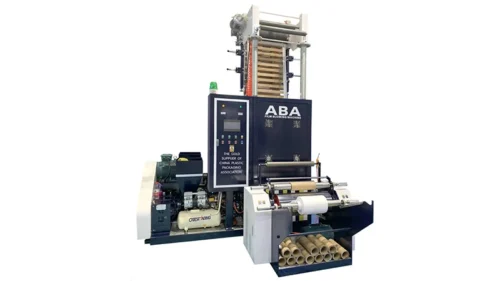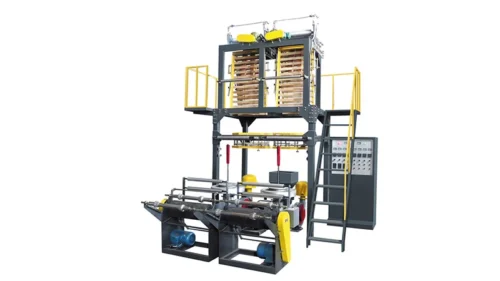
In the plastic film production industry, reducing costs and increasing profits are eternal themes for businesses. Today, with the combination of ABA blown film machine technology and calcium carbonate filling, film manufacturers are ushering in an innovative opportunity to revolutionize both production processes and cost structures.
Cost Optimization Principle of Calcium Carbonate in Film Production
Calcium carbonate (CaCO₃), as a common and low-cost inorganic mineral filler, is widely used in plastic processing. Through the precision extrusion system of the ABA blown film machine, calcium carbonate is added to the middle layer (B layer) of the film at a certain ratio. This significantly reduces raw material costs while ensuring the basic performance of the film.
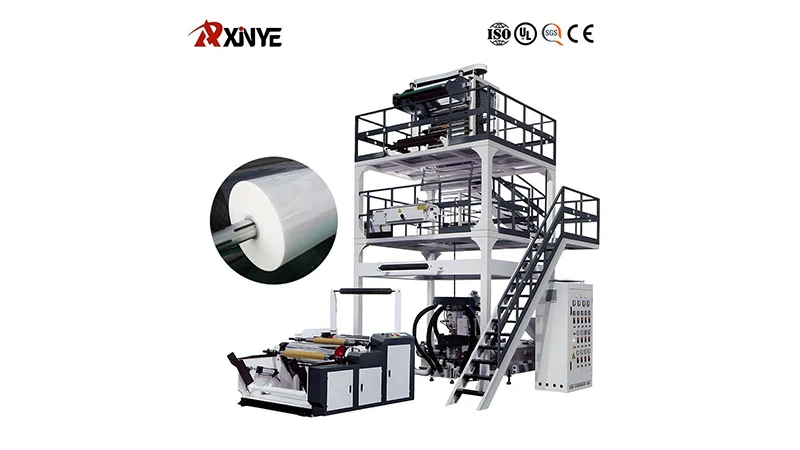
The key to this process lies in the unique three-layer structure design of the ABA blown film machine: the outer layer (A layer) uses pure raw materials to ensure surface performance, the middle layer (B layer) incorporates a high proportion of calcium carbonate, and the inner layer (A layer) returns to high-quality raw materials to guarantee heat-sealing performance. This structure maintains the functional integrity of the film while achieving substantial cost optimization.
Economic Benefit Analysis
The most direct effect of adding calcium carbonate is the reduction in the use of expensive resin raw materials. Typically, the unit price of calcium carbonate is only 1/3 to 1/5 that of plastic resin. Appropriate addition can lower raw material costs by 15%-30%. For film production enterprises with monthly outputs of hundreds of tons, this translates to monthly savings of several hundred thousand yuan in direct material costs.
More importantly, this cost optimization does not sacrifice product quality. The precise control system of the ABA blown film machine ensures the uniform dispersion of calcium carbonate in the middle layer of the film, maintaining its mechanical strength and basic functions. Additionally, the high filler proportion in the middle layer can enhance the film’s stiffness and opacity, making it suitable for various packaging applications.
Key Points for Process Implementation
Successfully implementing this strategy requires attention to several key technical points: First, the particle size and surface treatment of the calcium carbonate must meet film production requirements. Second, the addition ratio needs to be scientifically adjusted based on the end use. Finally, the screw design and temperature control of the ABA blown film machine require corresponding optimization to ensure good melt flow and dispersion.
Our company’s ABA blown film machine is specifically optimized for high-filler production. Equipped with a strong mixing screw and a precise temperature control system, it can stably achieve production processes with calcium carbonate addition ratios as high as 30%-40%, creating maximum cost advantages for our clients.
Dual Benefits for Environment and Market
Beyond direct economic benefits, adding calcium carbonate also brings environmental advantages: it reduces the use of petroleum-based plastics, lowers the carbon footprint, and aligns with green manufacturing trends. Simultaneously, cost reduction provides clients with greater pricing flexibility in market competition, enabling them to secure orders with more favorable prices and expand market share.
Conclusion
In the increasingly competitive film market, the innovative process of adding calcium carbonate via an ABA blown film machine offers clients tangible profit growth opportunities. This technology is not only a powerful tool for cost control but also an effective pathway for enterprise transformation, upgrading, and enhanced market competitiveness. Optimize your production process now and usher in a new era of low-cost, high-quality film production.
Click to learn about our ABA blown film machine specifically designed for high-filler production and to obtain customized solutions.