In the plastic film manufacturing industry, enhancing production capacity and flexibility remains a core goal for enterprises. Faced with multi-specification, multi-batch order demands, traditional single-head blown film machines often require frequent shutdowns for product changeovers, constraining production efficiency and market responsiveness. The widespread adoption of dual-head blown film machines is revolutionizing the industry with its groundbreaking design philosophy, unleashing transformative productivity.
Advantage One: Doubled Production Capacity, Significantly Lowering Overall Costs
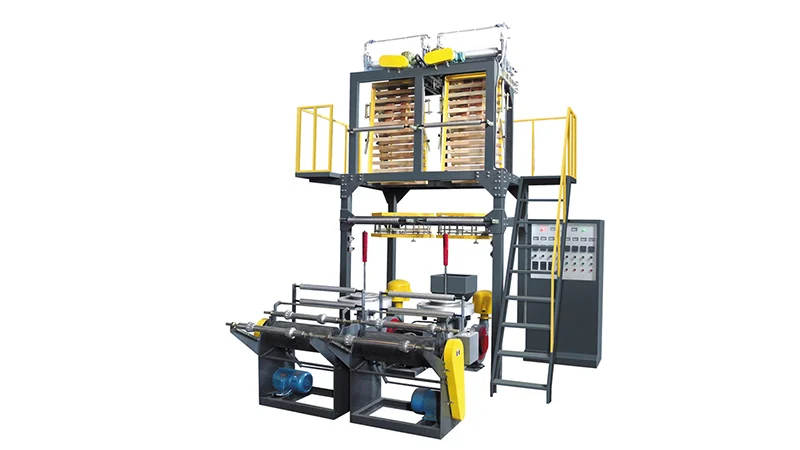
The most direct advantage of dual-head blown film machines lies in their dual-die parallel production capability. One machine can simultaneously and stably produce two rolls of film, theoretically doubling output per unit of time. This not only maximizes the utilization of factory space and energy consumption but also dilutes equipment investment, labor, and management costs. The overall production cost per roll of film is significantly reduced, granting enterprises a core competitive edge in the market.
Advantage Two: Flexible Production, Adapting to Diverse Orders
The diversification of market demands requires production lines to possess rapid response capabilities. Dual-head blown film machines provide enterprises with unprecedented production flexibility. Through advanced control systems, the two dies can be set to produce films of different widths and thicknesses, or even use different raw materials. This allows for the simultaneous manufacturing of two different products within a single production cycle, perfectly adapting to small-batch, multi-specification order requirements and greatly reducing downtime for die changes and material purging.
Advantage Three: High Stability and Uniformity Assurance
Thanks to modern integrated control technology, high-quality dual-head blown film machines achieve precise, synchronized regulation of temperature, pressure, and extrusion speed for the two independent dies. This ensures highly consistent thickness uniformity and physical properties of the films produced from both heads. The product quality is stable and reliable, meeting the stringent requirements of high-end packaging, agricultural coverings, and other demanding applications.
Advantage Four: Energy Saving and Consumption Reduction, Green Production
From an energy utilization perspective, compared to operating two independent single-head machines, one dual-head blown film machine shares a single set of power, transmission, and main control systems, reducing redundant energy consumption. The energy consumption ratio per unit of output is lower, demonstrating the green economic benefits of intensive production.
Advantage Five: Space and Labor Savings
One dual-head machine occupies far less floor space than two single-head machines, optimizing factory layout. Simultaneously, one skilled operator can monitor the operation of both production units, increasing output per capita and simplifying production management processes.
In summary, dual-head blown film machines are no longer merely tools for simple output duplication. They represent strategic equipment that drives film manufacturing enterprises toward flexible, intelligent, and efficient upgrades. Investing in dual-head technology is an investment in both future production efficiency and market adaptability.