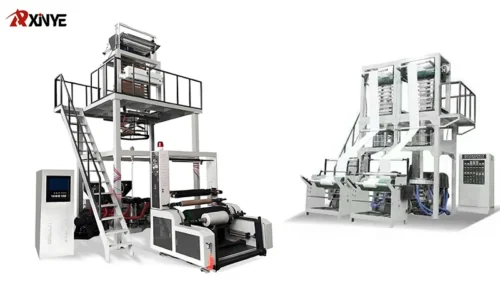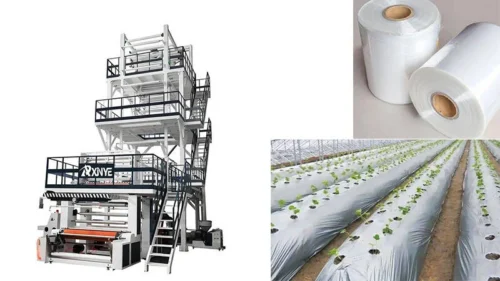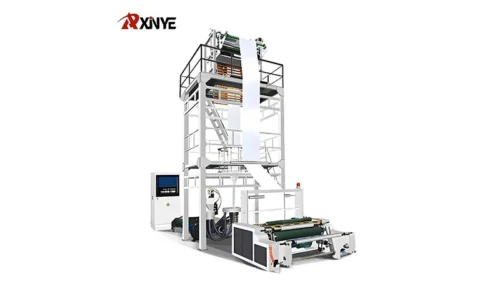
A blown film machine is a key piece of plastic processing equipment that heats and melts plastic pellets, then inflates them with compressed air to form a continuous film. It’s widely used in packaging, agriculture, food, and other fields, making it the mainstream equipment for industrial plastic film production.
With technology constantly evolving, improving the production efficiency of blown film machines is a topic that professionals care about. Compared to single-layer blown film machines, the production efficiency of multi-layer blown film machines is clearly noticeable. Let’s take a look at the table below.
| Comparison Dimension | Single-layer blown film machine | Three-layer ABA multilayer blown film machine |
| Typical hourly output | 35-130kg | 80-180kg |
| Maximum film width | 1200mm | 1700mm |
| Thickness tolerance | ±5% | ±4% |
| Compatible raw material types | Only a single type of PE/PP general material | 2-3 types of materials with different properties |
| Overall production efficiency improvement | Baseline 100% | Over 30% higher than single layer |
From the table, it can be seen that multi-layer blown film machines can increase overall production capacity by more than 30% compared to traditional single-layer equipment. So how do they boost productivity? Let’s take a closer look.
Synchronous Co-Extrusion in One Step
Multiple independent extruders melt different types of raw materials simultaneously and directly combine them into a multi-layer tubular melt in the die. This eliminates the need for secondary lamination processes, saving over 30% of processing time by skipping steps like lamination and curing.
Efficient Cooling System Speeds Up Forming
The standard IBC internal bubble cooling system forces cold and hot air to exchange inside the bubble. Combined with a labyrinth counterflow fan ring, the cooling efficiency is over 50% higher than traditional single-layer equipment. This speeds up bubble forming significantly, breaking the cooling speed bottleneck of conventional blown film machines and enabling the equipment to maintain higher pull speeds for extended periods.
High-Precision Control Reduces Downtime Losses
Equipped with a ±1℃ temperature control system, online thickness gauge, and melt pump with flow error controlled within ≤1%, film thickness uniformity deviation is less than ±5%. This greatly reduces waste caused by uneven thickness or crystallization exceeding limits. Some high-end production lines can reach a yield rate of 99.5%, significantly improving effective output. The hydraulic automatic screen changer and one-click specification change function can cut material or product changeover downtime by over 70%, greatly increasing the machine’s effective operating time.
Material Optimization Achieves Lightweight, Higher Output
Through layered design, the film can be made thinner while maintaining strength and barrier performance. This means the same weight of raw material produces more finished film, effectively increasing output per unit of material. Additionally, recycled material can be used in middle layers to lower formulation cost.
Summary
Multi-layer blown film machines mainly improve production efficiency through co-extrusion, efficient cooling, and intelligent control technologies, achieving significant gains by simplifying processes, increasing output, and reducing waste. If you’re still looking for high-quality, high-efficiency blown film machines, feel free to contact us. As a professional blown film machine manufacturer, Xinye is always ready to serve you.