There are many ways to classify blown film machines, such as by the head, by the material, by the number of layers, and so on. For beginners, even if you know that blown film machines can be divided into different types, you might still wonder what the differences are between them. For example, what’s the difference between a twin head blown film machine classified by the head and a two layer co-extrusion film blowing machine classified by layers?
This article takes the differences between a twin head blown film machine and a two layer co-extrusion film blowing machine as an example to dive into the relevant knowledge of blown film machines.
Core Differences
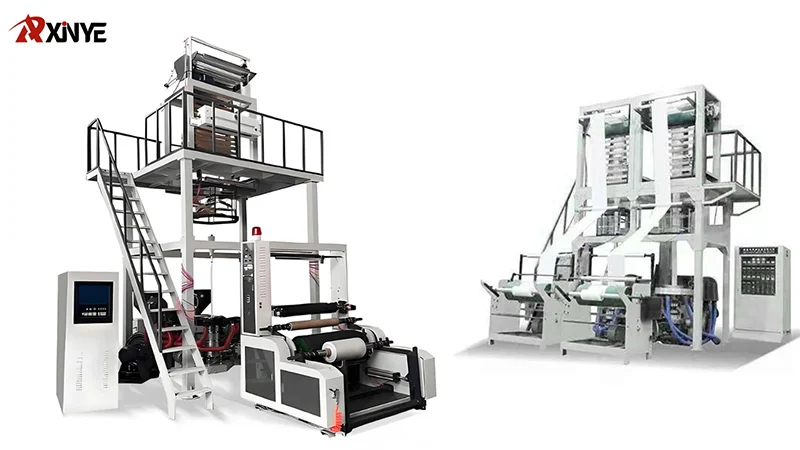
The core difference between a twin head blown film machine and a double-layer co-extrusion blown film machine is that their design goals are completely different: the twin head blown film machine focuses on “doubling production lines for higher output,” producing 2 separate single-layer films at the same time; the two layer co-extrusion film blowing machine focuses on “material compounding for better performance,” producing only 1 inseparable double-layer composite film. Their structural logic and product characteristics are completely distinct. Let’s look at the table below:
| Comparison Dimensions | Twin Head Blown Film Machine | Two Layer Co-extrusion Film Blowing Machine |
| Core Structure | 1-2 extruders, 2 completely independent die heads, with 2 sets of independent cooling, traction, and winding systems downstream. | 2 independent extruders, 1 set of co-extrusion composite die head, with only 1 set of cooling, traction, and winding system downstream. |
| Output Form | Can produce 2 completely independent single-layer films at the same time, which don’t combine with each other. | Can only produce 1 roll of double-layer composite film, where the two layers of melt fuse together in the die as one and cannot be separated. |
| Film Structure | Each roll of film is a single-layer structure, with no interlayer lamination. | A single roll of film can be a two-layer co-extruded structure, allowing the performance of different materials to be combined. |
| Core Goals | Double production capacity without adding an entirely new production line, and reduce energy consumption per unit product. | Break through the performance limits of single-layer films, achieving special properties like high strength and high barrier through combinations of different materials. |
| Typical Capacity Performance | A single line can produce 2 rolls of film at the same time, with a capacity close to the total of 2 separate single-head machines. | If only producing 1 roll of film, the daily output is usually 2-5 tons, but the main advantage isn’t just in increasing the output. |
| Material Compatibility Logic | Both extruders can feed the same common PE material, no special material matching needed. | Each extruder can also feed different materials (like LDPE, HDPE, PE, PA) to achieve complementary functions. |
Differences in Working Principles
- Twin head blown film machine: The molten plastic melt is delivered through a distribution structure into two completely independent die heads, each forming a separate film bubble. They follow independent cooling, drawing, and winding paths, ultimately producing two completely independent single-layer films. Some models can produce films of different widths and colors simultaneously.
- Two layer co-extrusion film blowing machine: Two extruders separately deliver melts of different formulations into the same coextrusion die head. Inside the die’s layered channel, the two melts adhere uniformly and are blown together. The two layers merge in a laminar flow state without turbulent mixing, creating a single, inseparable double-layer composite film with mechanical strength over 30% higher than single-layer film.
Typical Application Scenarios
- Choose a twin head blown film machine: Suitable for large-scale production of ordinary single-layer garbage bags, shopping bags, and vest bags. It can simultaneously produce films of two different widths, saving about 30% of floor space compared to purchasing two separate single-head machines and reducing energy consumption by roughly 15%.
- Choose a two layer co-extrusion film blowing machine: Suitable for producing courier bags, food preservation bags, and high-strength industrial packaging films. By pairing an inner layer of adhesive LDPE with an outer layer of high-strength HDPE, it achieves moisture-proof and puncture-resistant composite performance. It can also produce special appearance products like striped films.
Conclusion
From the above analysis, it’s easy to understand the differences between twin head blown film machine and two layer co-extrusion film blowing machine. If you’re looking to purchase a blown film machine, Xinye offers high-quality options for you to choose from.